
We offer guidance for smarter real estate decisions, because smarter real estate decisions make for better outcomes.
Real estate decisions often become more consequential as the transaction progresses. An initial conversation can become a representation agreement. An interesting property can become an accepted offer. A condition intended to provide time for investigation can eventually be waived. A commercial space that appears suitable can become a long-term lease obligation. An investment opportunity can become years of financial and operational responsibility.
My approach to real estate is built around a simple principle: Clients should understand what they are agreeing to, what assumptions they are relying upon, what protections they may be giving up and what obligations they may be taking on before the decision becomes difficult or expensive to reverse.
That is what Guidance for Smarter Real Estate Decisions means in practice.
The objective is not to make every transaction complicated. It is to recognize the decisions that genuinely matter, understand the information available at the time, identify what still needs to be investigated and help the client make a reasoned decision before becoming committed.
This approach applies across residential, commercial, industrial, investment, leasing and business-related real estate transactions. The specific issues may change, but the underlying principle remains the same: better-informed decisions generally create better opportunities to manage risk, negotiate effectively and structure the transaction around the client’s actual objectives.
The Decisions Behind the Transaction
Most real estate transactions contain a series of decision points. Some are routine. Others can materially affect price, risk, flexibility, financing, future obligations or the client’s ability to change direction later.
My role is not simply to move the transaction from one stage to the next. It is to help identify when a decision deserves closer examination and to ensure the client has an appropriate understanding of its implications.
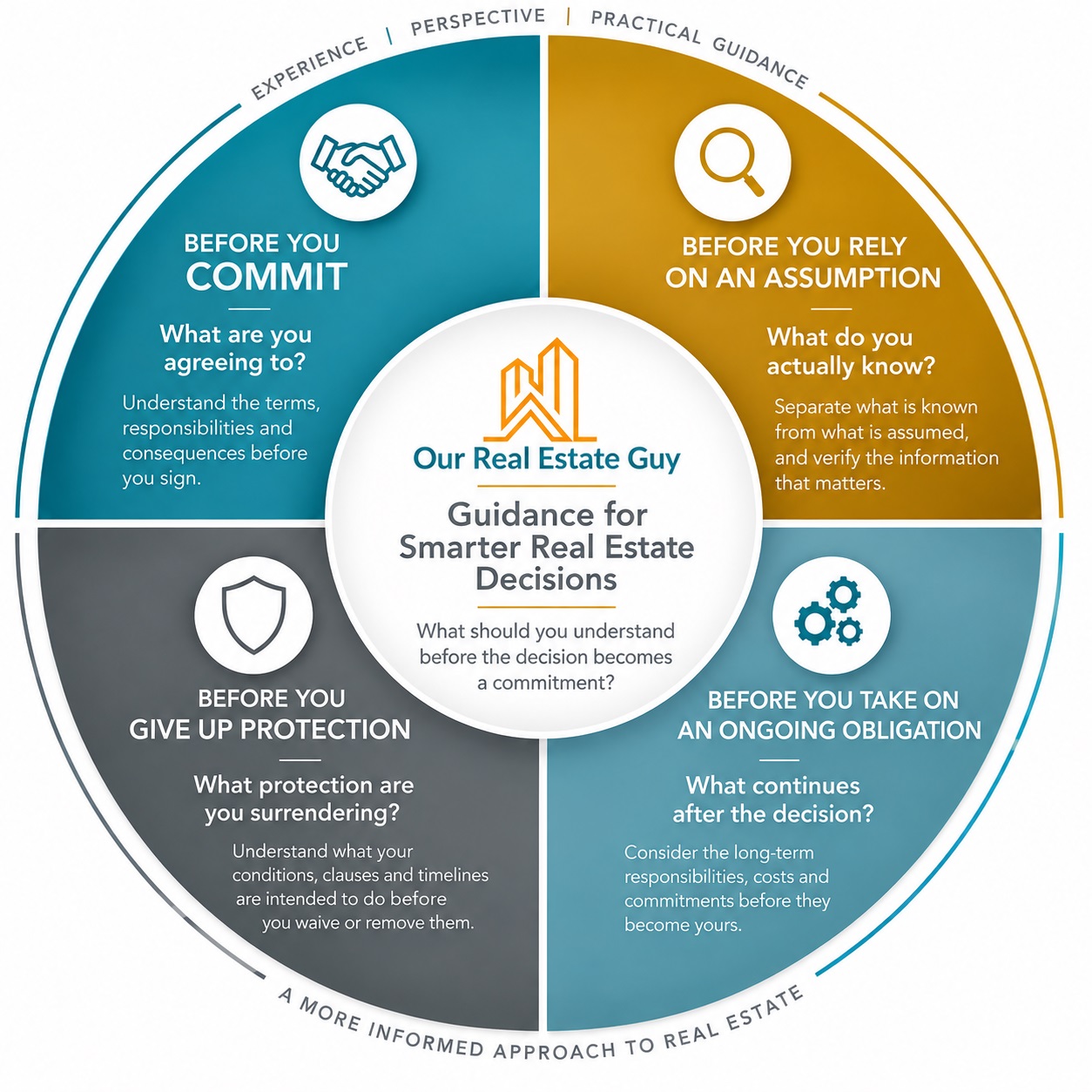
Those decisions can generally be viewed through four questions.
Before You Commit — What Are You Agreeing To?
Commitment can occur long before closing.
Signing a representation agreement can establish professional responsibilities, fees, exclusivity and continuing obligations. Accepting an offer can bind a seller to terms that involve more than price. Making an unconditional offer can expose a buyer to risks that would otherwise have been investigated through conditions. A commercial lease can create operating and financial responsibilities that continue for many years.
The important question is therefore not simply whether a document is ready to sign.
It is whether the client understands what the agreement requires, what flexibility remains, what happens next and what consequences may follow if circumstances change.
This can become particularly important:
- before signing a representation agreement;
- before making an unconditional offer;
- before accepting the highest offer;
- before accepting a conditional offer;
- before signing a commercial lease;
- before agreeing to an assignment; or
- before choosing a transaction structure whose consequences may extend beyond closing.
A well-structured transaction begins with understanding the commitment being made rather than discovering its consequences afterward.
Before You Rely on an Assumption — What Do You Actually Know?
Real estate decisions frequently depend on assumptions.
A property may already be used for a particular purpose, but that does not necessarily establish that another intended use will be permitted. A seller may provide information about a property, but some matters may still require independent verification. A commercial lease may advertise an attractive base rent while additional occupancy costs materially change the economics. An investment may show a compelling projected return without fully reflecting vacancy, capital requirements or operating risk.
Good due diligence helps separate what is known, what has been represented, what is being assumed and what still needs to be verified.
This question becomes particularly important:
- before relying on seller-supplied information;
- before assuming a property supports the intended use;
- before assuming an existing use establishes legal compliance;
- before relying on projected investment returns;
- before assuming base rent represents the true cost of occupancy;
- before relying on existing tenant income without examining the underlying leases and obligations; or
- before deciding that a property problem is either insignificant or impossible to resolve.
The purpose of investigation is not to find reasons to avoid a transaction. It is to understand the transaction well enough to decide whether the opportunity still makes sense once the assumptions have been tested.
Professional Insight
A decision can appear straightforward when the assumptions behind it remain unexamined. Due diligence adds value by identifying which assumptions deserve verification before they become part of the commitment.
Before You Give Up Protection — What Was the Protection Intended to Do?
Conditions, clauses, timelines and other contractual protections exist for a reason.
A financing condition may allow time to determine whether funding is sufficiently certain. A property-inspection condition may allow physical concerns to be investigated. A due diligence condition in a commercial transaction may provide an opportunity to examine leases, environmental matters, zoning, operating information or other issues before the buyer becomes fully committed.
Reaching the deadline does not necessarily mean the underlying risk has disappeared.
Before giving up a contractual protection, the client should understand what concern it was intended to address, what information has been obtained, what remains uncertain and what risk will be accepted once the protection is removed.
That can matter:
- before waiving a condition;
- before removing a financing condition;
- before accepting extended conditional uncertainty;
- before assuming a standard clause provides the protection intended;
- before agreeing to wording that changes notice, timing or termination rights; or
- before deciding that an unexpected problem should automatically end the transaction.
A condition should not be treated merely as another date on the transaction calendar. Its value lies in the decision it allows the client to make once additional information becomes available.
Before You Assume the Standard Clause Protects You
Standard forms and commonly used clauses provide useful frameworks, but the presence of familiar wording does not automatically mean a particular risk has been fully addressed.
The effectiveness of a clause depends upon what it actually says, how it interacts with the rest of the agreement, what must occur for it to operate and what happens if a party fails to comply with its requirements.
This is one area where careful documentation can materially affect the transaction. The question is not simply whether a clause exists, but whether the wording reflects the circumstances, allocates the intended risk and produces a sufficiently clear result if the provision has to be relied upon.
Before You Take On an Ongoing Obligation — What Continues After the Decision?
Some of the most important real estate obligations begin rather than end when the transaction closes.
A buyer of a tenanted property may inherit leases, tenants and landlord responsibilities. Someone creating a second suite may take on ongoing compliance, maintenance and tenancy obligations. A commercial tenant may be responsible for repairs, operating expenses, restoration or other obligations throughout the lease term. A property owner who decides to self-manage may assume significant documentation, maintenance, compliance and tenant-management responsibilities.
The purchase price or lease rate therefore tells only part of the story.
Before taking on an ongoing obligation, the client should understand what responsibilities will continue, what they may cost, how they could affect future flexibility and whether the arrangement remains appropriate for the client’s objectives.
That becomes particularly relevant:
- before buying a tenanted investment property;
- before becoming a landlord;
- before creating or purchasing a second suite;
- before deciding to manage a rental property personally;
- before entering a long-term commercial lease;
- before accepting repair, maintenance or operating-cost obligations; or
- before assuming that closing means every transaction responsibility has ended.
Long-term consequences deserve to be considered before they become long-term obligations.
Some Decisions Deserve a Closer Look
The four questions above apply to many different transactions, but certain decision points repeatedly deserve particular attention.
Before You Sign the Representation Agreement
Understand who represents you, what services will be provided, how compensation works, how long the relationship lasts and what obligations may continue after it ends.
Before You Make an Unconditional Offer
Understand what risks would ordinarily have been investigated through conditions and whether you are comfortable accepting those risks without that additional opportunity for review.
Before You Waive the Condition
Ask whether the concern the condition was designed to protect you from has actually been resolved rather than simply whether the deadline has arrived.
Before You Accept the Highest Offer
Consider price together with conditions, financing, deposit, timing, certainty and the likelihood that the transaction can actually be completed as agreed.
Before You Sign the Commercial Lease
Understand not only the rent, but the obligations that may affect occupancy cost, operations, maintenance, renewal, assignment and future flexibility.
Before You Assume the Property Supports Your Intended Use
An attractive property or existing use does not necessarily establish that zoning, occupancy, building requirements or other restrictions will support what you intend to do there.
Before You Buy a Tenanted Investment Property
Understand the tenants, leases, income, expenses and obligations that are being acquired along with the real estate.
Before You Rely on Projected Investment Returns
Understand the assumptions behind the numbers and determine whether vacancy, operating expenses, capital requirements, financing or other risks materially affect the expected return.
These are not the only important decision points in real estate. They are examples of situations where the cost of misunderstanding the issue can increase considerably once the client becomes committed.
Advice Should Reflect the Transaction
Not every client requires the same level of analysis, and not every property creates the same risks.
A conventional residential purchase may require careful attention to financing, property condition, title, condominium documentation or future suitability. An investment property may introduce tenancy, operating-cost and return considerations. A commercial or industrial acquisition may add zoning, environmental, building, lease and operational issues. A business transaction may require several professional disciplines to work together.
The appropriate level of advice should therefore reflect the actual transaction.
My role is to help identify the issues that matter, distinguish between real estate questions and matters requiring another professional, coordinate appropriate investigation where necessary and help the client understand how the available information should influence the decision.
A lawyer, accountant, lender, engineer, inspector, environmental consultant, contractor, property manager or other professional may sometimes need to become involved. Recognizing when another discipline is required is part of sound advisory work, not a limitation of it.
Negotiation Is More Than Price
Price is important, but many transaction outcomes are shaped by the terms surrounding the price.
Conditions, closing dates, deposits, financing flexibility, representations, repair obligations, lease provisions, environmental protections, assignment rights and timing can materially affect the value and certainty of a transaction.
Effective negotiation therefore begins with understanding what matters most to the client.
Sometimes that means improving price. Sometimes it means obtaining additional protection, reducing uncertainty, changing timing or restructuring an obligation. Occasionally, the strongest advice may be to investigate further, renegotiate or reconsider the transaction entirely.
The objective is not simply to win individual negotiating points. It is to structure the overall transaction in a way that supports the client’s priorities while understanding the risks being accepted.
Documentation Should Support the Decision
Real estate agreements translate business decisions into contractual obligations.
That makes documentation an important part of transaction strategy.
Clear wording can help establish what each party is expected to do, what conditions must be satisfied, when notice must be given, how risk is allocated and what happens when circumstances change. Poorly matched or ambiguous wording can create uncertainty even where the parties initially believed they understood the agreement.
This does not mean every transaction requires elaborate drafting.
It means the documentation should reflect the decision the parties believe they are making.
Where a legal interpretation or customized legal drafting is required, appropriate legal advice should be obtained.
Experience Behind the Approach
My perspective has been shaped by more than conventional residential sales.
It includes experience in residential, commercial, industrial, investment and leasing transactions, together with brokerage leadership, property-management knowledge, regulatory compliance responsibilities and earlier executive and operational experience within large industrial organizations.
That broader background influences the way I approach real estate decisions. Commercial and operational experience encourages attention to process, documentation, risk, coordination and the practical consequences of an agreement—not simply whether the transaction can be completed.
Professional education and industry credentials include FRI, CRB, CLO, MCNE, RENE, ABR®, SRS® and property-management studies, together with continuing education in negotiation, brokerage leadership, ethics, transaction management and related real estate disciplines.
Professional development does not replace judgment. It provides additional frameworks and tools that can support better analysis when combined with experience and a clear understanding of the client’s objectives.
Professional Representation Is a Mutual Commitment
My approach to representation is built on the idea that professional service carries responsibilities on both sides.
When I accept an engagement, I commit time, analysis, preparation, negotiation, documentation, coordination and other professional resources to the client’s matter. In return, I ask clients to enter the relationship with a corresponding commitment to the representation process and the agreed service structure.
This means my representation agreements are not based on the assumption that professional services automatically become free if a client later decides not to proceed or if a transaction does not complete. Depending upon the circumstances, the agreement may provide for reimbursement of reasonable expenses or for payment of a professional fee where that fee has already been earned.
Those terms are explained before representation begins so that the relationship starts with a clear understanding of responsibilities, costs and expectations.
Understand the obligation before it becomes the commitment.
Listening Comes Before Strategy
Good advice starts with understanding what the client is actually trying to accomplish.
Two buyers considering the same property may have very different priorities. Two sellers receiving similar offers may view certainty, timing or price differently. A landlord and tenant negotiating the same lease naturally approach risk from different perspectives.
That is why the process begins with listening.
The client’s objectives, experience, financial circumstances, concerns, intended use, desired level of involvement and tolerance for uncertainty all influence what advice may be appropriate.
Not every issue requires the same response, and not every risk needs to be eliminated.
The objective is to identify what matters enough to influence the decision.
Residential, Commercial, Leasing and Advisory Services
The same decision-based approach applies across different areas of real estate, although the issues naturally change with the transaction.
Buying Real Estate
Buyer representation can involve property evaluation, pricing, negotiation, due diligence, conditions, documentation and transaction coordination, with the level of professional support adapted to the buyer and transaction.
Selling Real Estate
Seller representation includes pricing, preparation, marketing, offer analysis, negotiation, documentation and transaction management, with particular attention to the relationship between price, certainty, conditions and overall outcome.
Leasing Real Estate
Leasing decisions can involve tenant selection, intended use, occupancy cost, lease structure, repair obligations, renewal rights and other responsibilities that may continue long after the lease is signed.
Advisory & Consulting Services
Independent advisory support is available where the client needs help evaluating a real estate decision, transaction structure, due diligence concern, lease issue or other matter that may not require conventional full representation.
Explore Advisory & Consulting Services
Guidance for Smarter Real Estate Decisions
Real estate decisions do not become important only at closing.
They become important whenever a client is about to make a commitment, rely upon an assumption, give up a protection or take on an obligation whose consequences may be difficult to reverse later.
My role is to help clients understand those moments clearly enough to make informed decisions based on the property, the transaction and their own objectives.
That is the approach behind:
Guidance for Smarter Real Estate Decisions.
Buying Real Estate | Selling Real Estate | Leasing Real Estate
Services, Fees & Pricing | Advisory & Consulting Services
Related Resources
 A Smarter Approach to Representation
Understanding the RECO Information Guide
What Duties Does a REALTOR® Owe You in Ontario?
Can You Work With More Than One REALTOR® in Ontario?
Why Documentation Matters in Real Estate Transactions
The Risks of Poorly Drafted Clauses
What Commercial Tenants Should Review Before Signing a Lease
Commercial Property Due Diligence Checklist