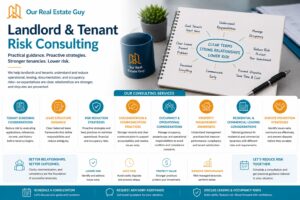
Helping Landlords and Tenants Better Understand Leasing, Documentation, Occupancy, and Operational Risks
Many landlord and tenant disputes do not arise because either party intended conflict. Instead, they often develop from unclear expectations, incomplete documentation, poor communication practices, inadequate screening, operational misunderstandings, or poorly structured lease agreements.
Professional Landlord & Tenant Risk Consulting is intended to help landlords, tenants, investors, and property owners better understand potential leasing and occupancy risks before they develop into costly disputes, financial losses, vacancies, enforcement actions, or operational challenges.
These services are approached from:
- a leasing perspective,
- an operational risk management perspective,
- a property management perspective,
- and a practical real estate advisory perspective.
The objective is not simply to solve problems after they occur, but to help clients identify and reduce potential risks before they arise.
Tenant Screening Considerations
One of the most significant risk management opportunities available to landlords occurs before a tenancy begins.
Tenant screening considerations may include:
- credit review considerations
- employment verification practices
- income verification approaches
- rental history review
- reference verification procedures
- application review processes
- occupancy verification considerations
- guarantor and co-signer discussions
- documentation collection practices
- record retention considerations
The objective is to help landlords develop consistent, fair, and defensible screening practices while reducing future occupancy and payment-related concerns.
Lease Structure Guidance
Lease agreements establish the operational framework for the tenancy.
Poorly structured lease agreements may create:
- ambiguity,
- misunderstandings,
- enforcement challenges,
- occupancy conflicts,
- maintenance disputes,
- and avoidable financial exposure.
Lease structure guidance may include:
- lease clause review considerations
- amendment procedures
- maintenance obligations
- utility allocation provisions
- parking provisions
- storage provisions
- occupancy restrictions
- guest and additional occupant provisions
- communication requirements
- documentation standards
- operational responsibility allocation
The objective is to improve clarity, reduce ambiguity, and support stronger landlord-tenant relationships.
Risk Reduction Strategies
Many landlord and tenant disputes can be substantially reduced through proactive planning, documentation, communication, and operational consistency.
Risk reduction discussions may include:
- preventative documentation practices
- lease administration procedures
- occupancy management considerations
- maintenance reporting procedures
- inspection practices
- recordkeeping recommendations
- payment tracking procedures
- amendment documentation
- policy consistency
- operational expectation management
The objective is to help identify practical measures that may reduce misunderstandings, disputes, and future enforcement challenges.
Documentation & Communication Practices
Many tenancy disputes ultimately become documentation disputes.
Professional documentation and communication practices may help improve:
- accountability,
- consistency,
- clarity,
- and evidentiary support when concerns arise.
Topics may include:
- written communication practices
- notice documentation
- inspection records
- maintenance requests
- amendment documentation
- occupancy records
- payment records
- tenancy correspondence
- communication protocols
- record retention practices
Strong documentation often supports better outcomes regardless of whether concerns are resolved informally or through formal dispute resolution processes.
Occupancy & Operational Considerations
Occupancy arrangements frequently evolve over time.
Operational concerns may include:
- unauthorized occupants
- occupancy changes
- parking usage
- storage usage
- shared facilities
- utility allocation concerns
- property access procedures
- maintenance responsibilities
- occupancy restrictions
- operational rule enforcement
The objective is to help parties understand how occupancy decisions may affect long-term tenancy administration and risk exposure.
Property Management Awareness
Effective property management often extends beyond rent collection and maintenance coordination.
Property management awareness discussions may include:
- lease administration considerations
- maintenance management practices
- contractor documentation
- communication procedures
- inspection programs
- occupancy monitoring
- compliance awareness
- operational workflow considerations
- documentation controls
- risk management practices
These discussions are intended to help landlords better understand operational practices that may contribute to more effective tenancy management.
Residential & Commercial Leasing Considerations
Residential and commercial leasing often involve different operational risks and documentation requirements.
Residential considerations may include:
- tenant screening
- occupancy management
- maintenance obligations
- communication practices
- lease administration
Commercial considerations may include:
- occupancy cost allocation
- maintenance responsibilities
- operating expenses
- CAM/TMI awareness
- use restrictions
- operational obligations
- amendment management
- tenant compliance considerations
The objective is to help clients better understand the unique risks and responsibilities associated with each leasing environment.
Dispute Prevention Strategies
The most effective dispute is often the one that never occurs.
Dispute prevention discussions may include:
- expectation management
- lease clarity improvements
- amendment procedures
- documentation consistency
- communication protocols
- operational policy development
- occupancy management practices
- maintenance procedures
- issue escalation processes
- recordkeeping standards
The objective is to help landlords and tenants create clearer expectations and stronger working relationships before issues develop into formal disputes.
Who May Benefit From These Services
These services may be valuable for:
- residential landlords
- commercial landlords
- property owners
- real estate investors
- property managers
- residential tenants
- commercial tenants
- business owners
- first-time landlords
- multi-property owners
Particularly where:
- lease concerns exist,
- operational challenges are developing,
- documentation practices need improvement,
- tenancy disputes are emerging,
- or parties wish to proactively reduce future risk.
Fees & Pricing
Residential Landlord & Tenant Risk Consultation
Starting from:
$295 – $895
Depending upon:
- property complexity,
- number of tenancy concerns,
- documentation review requirements,
- and consultation scope.
May include:
- screening discussions,
- lease review considerations,
- occupancy risk observations,
- documentation recommendations,
- and dispute prevention guidance.
Commercial Leasing Risk Consultation
Starting from:
$750 – $3,500+
Depending upon:
- property type,
- occupancy complexity,
- lease structure,
- documentation volume,
- operational concerns,
- and consultation requirements.
May include:
- occupancy cost awareness,
- lease administration observations,
- operational risk discussions,
- amendment review considerations,
- and commercial leasing guidance.
Hourly Consulting Services
$250 – $400 per hour
For:
- specific leasing concerns,
- tenancy risk discussions,
- documentation review preparation,
- occupancy issues,
- dispute prevention planning,
- and operational consulting.
Professional Services Require Mutual Commitment
Professional representation is a mutual commitment. When I accept an engagement, professional time, analysis, preparation, marketing, property search, negotiation, documentation, due diligence, transaction management and other resources may begin to be committed to the client’s matter immediately.
For that reason, the representation relationship is not structured on the assumption that all professional services become free if the client later elects not to proceed or the transaction does not complete.
The applicable representation agreement identifies when the Brokerage’s professional fee is earned and payable. It may also provide for reimbursement of reasonable expenses where the representation agreement ends before completion and the Brokerage is not otherwise entitled to commission. The circumstances and applicable terms depend upon the type of representation and are explained in the representation agreement.
These provisions are reviewed before services begin. The objective is not to create an unexpected charge at the end of an engagement, but to establish at the beginning that both the client and the Brokerage are entering into a professional relationship with defined responsibilities and financial commitments.
Understand the obligation before it becomes the commitment.
Advisory Positioning & Service Scope
Landlord & Tenant Risk Consulting services are intended to provide practical observations and advisory guidance regarding leasing, occupancy, documentation, communication, and operational risk management considerations.
These services are not intended as:
- legal advice,
- accounting advice,
- property inspection services,
- engineering advice,
- or licensed paralegal services.
Clients are encouraged to obtain independent legal, accounting, engineering, inspection, or other professional advice where appropriate.
Discuss Your Landlord & Tenant Risk Concerns
Understanding potential leasing, occupancy, documentation, and operational risks before they become disputes may help landlords and tenants make more informed decisions, reduce uncertainty, improve communication, and strengthen long-term working relationships.
Professional Landlord & Tenant Risk Consulting services are intended to support clearer expectations, stronger documentation practices, improved operational awareness, and more effective risk management throughout the tenancy lifecycle.
 Book a Consultation Request Advisory Assistance Discuss Leasing & Occupancy Risk Concerns Move Forward with Clarity & Structure
Related Articles & Resources
Advisory & Consulting Services
Strategic Representation Structures
Lease Review & Advisory Services
Transaction Review & Advisory Services
Due Diligence & Risk Awareness Advisory Services
Landlord Representation Services
Tenant Representation Services
Ambiguous Lease Clauses: How Unclear Wording Creates Financial, Operational, and Relationship Risk