
Guidance for Smarter Leasing Decisions
Leasing real estate involves much more than finding a tenant or locating suitable space.
A lease can establish financial, operational and legal obligations that continue for months or years. For landlords, the quality of the tenant, the structure of the lease and the responsibilities accepted at the beginning of the tenancy can materially affect income stability, property condition and future management. For tenants, occupancy cost, permitted use, maintenance obligations, renewal rights and flexibility can significantly affect whether the property continues to meet personal or business needs.
My approach to leasing is therefore built around understanding the decision before it becomes the obligation.
Some clients require comprehensive representation throughout the leasing process. Others are experienced and prefer to manage more of the process themselves. In some situations, the immediate need is simply advice about a lease, tenant, property or occupancy issue before deciding how to proceed.
The appropriate approach should reflect the property, the parties and the consequences of the lease being considered.
Start With the Leasing Objective
Leasing should begin with more than a rental rate and an available property.
For a landlord, the objective may be stable income, a particular tenant profile, lower turnover, improved property use or a longer-term investment strategy. For a tenant, the priority may be affordability, location, operational suitability, flexibility, expansion potential or the ability to remain in the premises over time.
Those objectives influence the way the property should be marketed or searched, the terms that matter most in negotiation and the risks that deserve closer attention before an agreement is signed.
A residential lease, retail tenancy, office lease and industrial occupancy can involve very different considerations even though each is broadly described as “leasing.”
Understanding the purpose of the tenancy provides the foundation for the decisions that follow.
Choose How You Want to Lease
Landlords and tenants can require different levels of professional involvement depending upon the property and the leasing situation. If you already know the type of support you are looking for, you can go directly to the relevant option.
Tenant Representation | Landlord Representation | Advisory & Consulting
Not sure? Continue below to understand the decisions that may shape your leasing strategy.
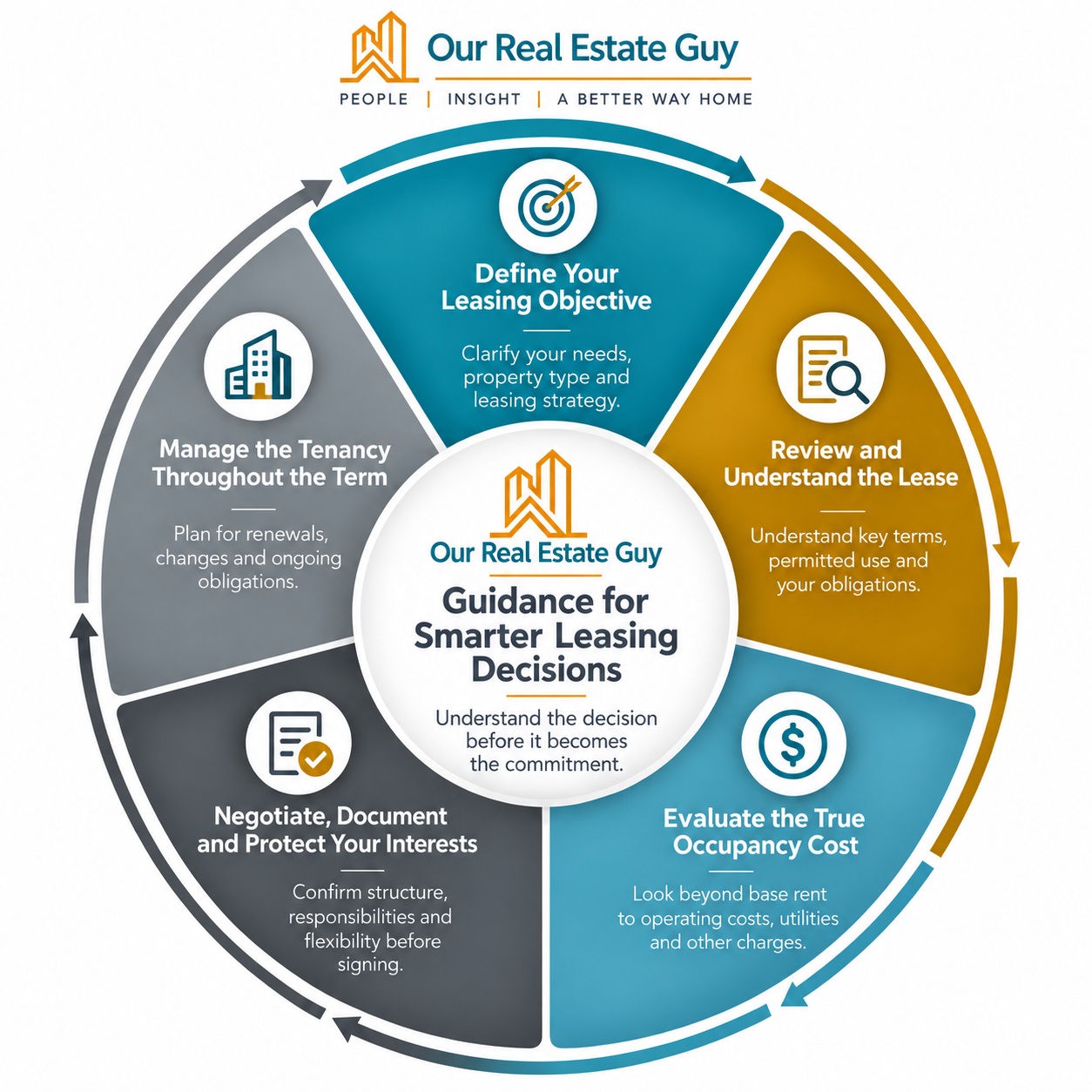
Decisions Worth Understanding Before You Lease
A lease often looks straightforward at the beginning because attention tends to focus on rent, location and availability.
The more consequential issues frequently appear in the details.
Before You Sign the Commercial Lease
A commercial lease can create obligations that continue for many years.
Rent is only one part of the commitment. Permitted use, additional rent, maintenance, repair obligations, insurance, renewal rights, assignment provisions, restoration obligations and operating restrictions can all affect the economics and practicality of occupying the property.
Before signing, the tenant should understand not only whether the space is attractive, but whether the lease structure supports the intended business use and future flexibility.
Related: What Commercial Tenants Should Review Before Signing a Lease | Triple Net Leases Explained | Industrial Leasing Terms | Sophisticated Real Estate Negotiations Involve More Than Price Alone
Before You Assume Base Rent Is the True Occupancy Cost
Base rent does not necessarily represent the full cost of occupying commercial space.
Depending upon the lease, the tenant may also be responsible for taxes, insurance, common-area maintenance, utilities, repairs, management costs and other operating expenses.
Those additional obligations can materially change the economics of the tenancy.
The useful question is therefore not simply “What is the rent?” but “What will it actually cost to occupy and operate from this property?”
Related: Triple Net Leases Explained | What Commercial Tenants Should Review Before Signing a Lease | Industrial Leasing Terms | Commercial Lease Review
Before You Assume the Existing Use Is Permitted
A property may currently be occupied for one purpose without necessarily supporting another proposed use.
For commercial and industrial tenants, zoning, permitted-use provisions, occupancy requirements, building characteristics and other restrictions can determine whether the business can operate as intended.
The lease itself may also restrict use more narrowly than municipal permissions would otherwise allow.
Where intended use is fundamental to the tenancy, it should be investigated before the tenant commits to the premises.
Related: Commercial Property Due Diligence Checklist | Common Due Diligence Failures | Environmental Concerns | Industrial Property Risks
Before You Assume the Space Will Support the Business
A property can appear suitable during a showing without necessarily supporting the operational requirements of the tenant.
Access, loading, ceiling height, electrical capacity, parking, signage, customer access, storage, ventilation, expansion requirements and other practical considerations may influence whether the space actually works.
The decision should therefore consider both the lease terms and the operational realities of the property.
Related: What Commercial Tenants Should Review Before Signing a Lease | Industrial Leasing Terms | Commercial Property Due Diligence Checklist | Transaction Structuring
Landlord Decisions Before the Tenancy Begins
For landlords, some of the most important leasing decisions occur before possession is ever given to the tenant.
Before You Accept a Tenant
Selecting a tenant is not simply a decision about whether the applicant can pay the first month’s rent.
Income stability, credit history, references, documentation, intended use, communication and overall suitability can all affect the quality of the tenancy.
The objective is not to search for a risk-free tenant. It is to understand the information available and make a reasoned decision about whether the applicant is appropriate for the property and the landlord’s objectives.
Related: The Risks of Improper Tenant Screening in Ontario | Tenant Screening and Lease Risk Guide | How Small Landlords Can Reduce Liability | Landlord & Tenant Risk Consulting
Before You Rely on Tenant Financial Information Without Proper Screening
Tenant applications can contain employment information, income statements, references, credit information and other supporting documentation.
Those materials are useful only to the extent that they are reviewed carefully and, where appropriate and lawful, verified.
A strong-looking application should not automatically replace a structured screening process, particularly where the landlord will be relying upon the tenant’s financial performance for an extended period.
Related: The Risks of Improper Tenant Screening in Ontario | Tenant Screening and Lease Risk Guide | How Small Landlords Can Reduce Liability | Landlord & Tenant Risk Consulting
Before You Assume the Highest Rent Produces the Best Tenancy
Rent matters, but so do tenant quality, term, stability, use, maintenance expectations and the likelihood of a successful long-term relationship.
An applicant willing to pay more may not necessarily provide the strongest overall tenancy if the financial position, proposed use or other aspects of the application introduce additional risk.
The landlord should therefore consider the complete tenancy rather than evaluating applicants solely by rental rate.
Related: Tenant Screening and Lease Risk Guide | The Risks of Improper Tenant Screening in Ontario | Sophisticated Real Estate Negotiations Involve More Than Price Alone | How Small Landlords Can Reduce Liability
Before You Assume the Standard Lease Clause Protects You
Standard forms and commonly used clauses provide useful starting points, but familiar wording does not automatically mean that the particular risk has been addressed.
The effectiveness of a clause depends upon what it requires, how clearly responsibilities are allocated, what notice may be required and what happens if circumstances change.
For residential tenancies, legislation can also limit what parties may contract for. Commercial leases generally allow considerably greater negotiation, making the wording itself even more important.
The practical question is therefore whether the clause actually addresses the issue and whether the parties understand how it is intended to operate.
Related: The Risks of Poorly Drafted Clauses in Ontario Real Estate | Contracts and Clauses You May See in Ontario Real Estate Transactions | Why Documentation Matters in Real Estate Transactions | What Commercial Tenants Should Review Before Signing a Lease
Before You Accept Ongoing Repair or Maintenance Obligations
Repair and maintenance responsibilities can have significant financial consequences over the life of a lease.
In residential tenancies, many obligations are governed by legislation and cannot simply be transferred through contract. Commercial leases, by contrast, can allocate substantial maintenance, repair and replacement responsibilities between landlord and tenant.
Those obligations should be understood before the lease is signed rather than when a major expense arises later.
Related: Triple Net Leases Explained | Industrial Leasing Terms | What Commercial Tenants Should Review Before Signing a Lease | Why Documentation Matters in Real Estate Transactions
Before You Give Up Flexibility
The longer the lease, the more important flexibility can become.
Renewal rights, assignment and subletting provisions, relocation rights, expansion options, termination provisions and use restrictions can determine whether the tenancy remains workable as circumstances change.
A term that seems unimportant when the business or household first moves in may become significant several years later.
The appropriate lease should therefore consider not only current needs, but reasonably foreseeable changes during the tenancy.
Related: What Commercial Tenants Should Review Before Signing a Lease | Industrial Leasing Terms | Triple Net Leases Explained | Sophisticated Real Estate Negotiations Involve More Than Price Alone
Before You Become a Landlord
Owning a rental property involves more than collecting rent.
Tenant screening, documentation, maintenance, communication, compliance and property management become ongoing responsibilities once the tenancy begins.
For investors considering a rental purchase or owners creating a second suite, those obligations should form part of the decision before the property becomes an operating rental.
The expected income needs to be considered together with the responsibilities required to produce and protect that income.
Related: How Small Landlords Can Reduce Liability | The Risks of Improper Tenant Screening in Ontario | Property Management Risk | Investment Property Advisory
Before You Decide to Manage the Property Yourself
Self-management can reduce direct property-management costs, but it also transfers responsibility for communication, documentation, maintenance coordination, compliance and tenant relations to the owner.
For some landlords that is entirely appropriate. For others, the time commitment and operational responsibility may be greater than expected.
The decision should therefore consider both financial cost and the landlord’s ability and willingness to manage the tenancy effectively.
Related: Risks of Not Employing a Property Management Professional | How Small Landlords Can Reduce Liability | Tenant Screening and Lease Risk Guide | Landlord & Tenant Risk Consulting
Residential and Commercial Leasing Require Different Thinking
Residential and commercial leasing share some underlying principles, but the legal and practical environments are substantially different.
Residential tenancies in Ontario operate within a heavily regulated framework. Tenant selection, deposits, rent increases, maintenance responsibilities, termination and enforcement are subject to statutory requirements that can limit the parties’ ability to negotiate around them.
Commercial leasing generally allows considerably greater contractual flexibility. That freedom creates opportunity, but it also places greater importance on negotiation and documentation because rent structure, repairs, operating expenses, permitted use, renewal, assignment and other obligations can be negotiated extensively.
The appropriate leasing approach should therefore reflect the type of tenancy rather than treating every lease as though the same rules and risks apply.
Choose the Leasing Service That Fits Your Position
Landlords and tenants approach the same property from different positions, so their representation requirements should not be treated as interchangeable.
The detailed service pages explain the scope, responsibilities and applicable fees. The options below are intended simply to direct you to the appropriate starting point.
Landlord Representation
Landlord Representation is available for residential, commercial and industrial property owners who want professional assistance with rental positioning, marketing, tenant evaluation, screening coordination, negotiation, documentation and lease execution.
Residential landlords may choose between landlord-controlled MLS® exposure and full-service tenant-placement representation, while commercial and industrial assignments can be structured according to the property and leasing objectives.
Explore Landlord Representation
Tenant Representation
Tenant Representation is available for residential tenants, business owners and commercial or industrial occupiers requiring assistance identifying, evaluating and securing suitable property.
Depending upon the assignment, services may include property search, lease analysis, occupancy-cost review, offer preparation, negotiation, due diligence coordination and transaction support through occupancy.
Advisory & Consulting Services
Sometimes the immediate need is not full leasing representation.
A landlord may need assistance evaluating a tenant, reviewing lease structure or considering operational risk. A tenant may want an independent review of occupancy costs, lease provisions or the suitability of a proposed transaction before proceeding.
Advisory services provide a way to obtain professional real estate guidance without beginning with complete transaction representation.
Explore Advisory & Consulting Services
A Smarter Approach to Leasing
Not every landlord or tenant requires the same level of professional involvement.
An experienced landlord may be comfortable handling inquiries, showings and negotiations while primarily requiring professional MLS® exposure. Another landlord may prefer comprehensive assistance from marketing through tenant placement and lease execution.
Likewise, residential tenant representation may be relatively straightforward, while a commercial or industrial leasing assignment may require substantial analysis of occupancy economics, lease structure and operational suitability.
The detailed service and pricing pages explain those alternatives separately so this page can remain focused on the decisions that matter throughout the leasing process.
Explore A Smarter Approach to Leasing
Professional Services Require Mutual Commitment
Professional representation involves a commitment on both sides. I commit professional time, analysis, negotiation, documentation, coordination and transaction support to the engagement, and clients are asked to make a corresponding commitment to the representation relationship.
The representation agreement explains when professional fees are earned and whether reasonable expenses may be reimbursable if the engagement ends before completion. These terms are reviewed before representation begins so that the financial commitment is understood in advance.
Professional Advice Sometimes Requires Other Professionals
Leasing transactions can involve legal, tax, accounting, engineering, environmental, insurance, financing and other specialized considerations.
Where an issue requires expertise outside the appropriate scope of real estate brokerage services, I may recommend that the landlord or tenant obtain advice from an appropriately qualified professional.
My role is not to replace those professionals. It is to recognize when their expertise may materially affect the leasing decision and help ensure the relevant issue is addressed before the parties become committed.
Leasing Real Estate in Durham Region and the GTA
Landlord and tenant representation is available throughout Durham Region and the Greater Toronto Area, including Oshawa, Whitby, Ajax, Pickering, Clarington and surrounding communities.
Services are available for residential rentals, investment properties, retail, office, industrial and other commercial leasing assignments, with the scope of professional involvement adapted to the property and transaction.
Start With the Leasing Decision
The most useful starting point is not necessarily choosing a leasing package.
It is understanding the property, the intended use, the parties involved, the obligations being considered and the amount of professional assistance that may be appropriate.
For landlords, that may mean deciding how the property should be positioned, what tenant profile is suitable and how much of the leasing process they want to manage personally.
For tenants, it may mean determining whether the property, occupancy economics and lease structure actually support their residential or business objectives.
From there, the appropriate path may be Landlord Representation, Tenant Representation or independent Advisory & Consulting support.
Related Leasing Resources
👉 Tenant Representation Services
👉 Landlord Representation Services
👉 Tenant Screening and Lease Risk Guide
👉 A Smarter Approach to Leasing
👉 Landlord Guidebook & Planning Resources
👉 Compare Our Leasing Service Options