
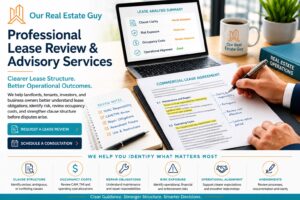
Clearer Lease Structure. Better Operational Outcomes.
Lease agreements are more than legal documents — they are operational and financial frameworks that may significantly affect occupancy rights, financial obligations, operational responsibilities, occupancy costs, maintenance expectations, amendment procedures, and long-term working relationships.
Poorly drafted or operationally unclear clauses may create:
- financial disputes,
- inconsistent interpretation,
- occupancy cost concerns,
- operational confusion,
- delayed enforcement,
- and avoidable conflict between parties.
Professional lease review and advisory services are intended to help landlords, tenants, investors, business owners, and property managers better understand:
- how lease clauses function operationally,
- what risks specific clauses are intended to manage,
- where ambiguity or drafting concerns may exist,
- and how stronger clause structure and documentation practices may help reduce future misunderstandings and disputes.
These services are approached from both:
- a contractual perspective, and
- an operational risk management perspective.
What May Be Reviewed
Professional lease review and advisory services may include review and discussion regarding:
- Lease clause structure and drafting clarity
- Ambiguous or conflicting clauses
- Occupancy cost and CAM/TMI allocation concerns
- Repair and maintenance obligations
- Utility allocation provisions
- Operational responsibilities and procedures
- Default and enforcement provisions
- Amendment and documentation procedures
- Landlord and tenant operational expectations
- Commercial and residential lease risk considerations
- Occupancy rights and use restrictions
- Timeline, notice, and termination provisions
- Clause enforceability and operational practicality
- Lease administration and operational workflow concerns
- Transaction-specific risk considerations
Why Clause Architecture Matters
From a professional advisory perspective, clause drafting should not be viewed simply as a legal exercise. Well-structured clauses are intended to:
- define expectations clearly,
- allocate responsibility appropriately,
- establish operational procedures,
- reduce ambiguity,
- improve enforceability,
- and support smoother long-term administration of the agreement.
Many disputes arise not because the parties intended conflict, but because the clause itself:
- lacked operational detail,
- failed to define timelines,
- omitted procedures,
- failed to establish remedies,
- or created uncertainty regarding obligations and expectations.
Sophisticated real estate advisors therefore focus not simply on what a clause says, but:
- what the clause is intended to accomplish,
- how it will function operationally,
- what risks it attempts to manage,
- and how it may be interpreted or enforced later if a dispute arises.
Common Risks Associated with Poorly Drafted Clauses
Poorly structured clauses may create:
- inconsistent interpretation,
- delayed enforcement,
- operational confusion,
- financial exposure,
- occupancy disputes,
- maintenance conflicts,
- communication breakdowns,
- or avoidable legal escalation.
Common concerns often include:
- vague wording,
- undefined obligations,
- missing timelines,
- subjective standards,
- incomplete procedures,
- unclear amendment rights,
- or undefined remedies and penalties.
In many situations, both parties believe they understand the clause until an operational issue arises later.
Examples of Lease Clause Architecture & Operational Risk Management
The following examples illustrate how professionally structured lease clauses may:
- define operational responsibilities,
- allocate financial obligations,
- establish administrative procedures,
- reduce ambiguity,
- improve enforceability,
- and support more effective long-term lease administration.
These examples are intended to demonstrate how sophisticated clause architecture attempts to anticipate operational issues before disputes arise.
COMMERCIAL CLAUSE – HEATING, VENTILATION & AIR CONDITIONING (HVAC)
Example Clause
HEATING, VENTILATION and AIR CONDITIONING: The parties acknowledge that notwithstanding that the Landlord owns the heating, ventilating and air-conditioning system servicing the Premises, and unless otherwise required or permitted by the Landlord as set out in this Section, the Tenant shall be solely responsible for all costs and expenses of operating, maintaining and repairing and replacing the heating, ventilating and air-conditioning system serving the Premises including entering into such maintenance and service contracts as are necessary for such operation, maintenance and repair. The Tenant shall provide the Manager of the Shopping Centre with a copy of such maintenance and service contract. If the heating, ventilating and air-conditioning system serving the Premises ceases to function properly, then the Tenant, using good business judgment, shall repair or replace such heating, ventilating and air-conditioning system serving the Premises at its sole cost and expense with a new system of a type as determined by the Landlord, acting reasonably, which shall become the Landlord’s property immediately upon affixation but which the Tenant agrees to operate, maintain and repair as set out above at its sole cost and expense.
What the Clause is Intended to Accomplish
This clause is intended to:
- clearly allocate operational responsibility for HVAC systems,
- establish maintenance expectations,
- transfer repair and replacement obligations to the Tenant,
- and reduce future disputes regarding system ownership versus maintenance responsibility.
Why It May Be Included
This type of clause is commonly included within commercial retail and shopping centre leases where:
- individual HVAC systems service specific tenant premises,
- operational consistency is required,
- and the Landlord wishes to avoid future disputes regarding repair responsibility, maintenance standards, or replacement obligations.
Clause Architecture Considerations
Professionally structured HVAC clauses often:
- distinguish ownership from operational responsibility,
- define maintenance obligations clearly,
- require maintenance contracts,
- establish replacement procedures,
- define approval rights,
- and address ownership of replacement equipment following installation.
COMMERCIAL CLAUSE – TENANT’S PROPORTIONATE SHARE OF OPERATING EXPENSES
Example Clause
a) In each Rental Year, the Tenant will pay to the Landlord its Proportionate Share of the Operating Expenses in monthly instalments, in advance.
b) The Tenant will pay the amounts payable under Section 6.04(a) according to estimates or revised estimates made by the Landlord from time to time in respect of periods determined by the Landlord. The Tenant’s payments will be made in monthly instalments in advance for the periods in respect of which the estimates are made. Within one hundred and eighty (180) days after the end of each Rental Year the Landlord will deliver to the Tenant a report certified by the Landlord of the amounts referred to in Section 6.04(a) together with a statement (a “Statement”) of the Tenant’s Proportionate Share of those amounts. If the Tenant has paid more than a Statement specifies, the excess will be refunded within thirty (30) days after delivery of the Statement (unless the Tenant is then in default under any term or condition of this Lease or it owes money to the Landlord in respect of its obligations under this Lease provided that once such default has been cured or money paid to the Landlord, the Landlord shall pay any such amount owing to the Tenant provided that such funds were not used by the Landlord to cure such default or applied on account of monies owed). If the Tenant has paid less than a Statement specifies, the Tenant will pay the deficiency within thirty (30) days of receipt of the Statement.
What the Clause is Intended to Accomplish
This clause is intended to:
- establish how operating expenses are allocated,
- define reconciliation procedures,
- establish payment timelines,
- and create administrative procedures for occupancy cost recovery and adjustments.
Why It May Be Included
This type of clause is commonly used within:
- commercial,
- retail,
- industrial,
- and multi-tenant properties
where tenants share common operating expenses associated with the property.
Clause Architecture Considerations
Professionally structured operating cost clauses generally:
- define payment procedures,
- establish reconciliation timelines,
- define deficiency and refund obligations,
- clarify default treatment,
- and establish administrative certainty regarding occupancy cost allocation.
COMMERCIAL CLAUSE – PEST CONTROL
Example Clause
PEST CONTROL: In order to maintain satisfactory and uniform pest control throughout the Shopping Centre, the Tenant shall engage for the Premises at its sole cost and expense such pest extermination contractor as may be acceptable to the Landlord, acting reasonably, and at such intervals as the Landlord requires. The Tenant shall ensure that its pest extermination contractor complies with all Applicable Laws governing the use of pesticides or other substances. If the Landlord, acting reasonably, determines that the Tenant’s pest extermination contractor is not performing its duties effectively and in compliance with all Applicable Laws, then the Landlord may, without notice, engage its own pest extermination contractor on the Tenant’s behalf without incurring any liability in respect thereof and the Tenant will pay to the Landlord the cost of the Landlord’s pest extermination contractor together with an administration fee of fifteen percent (15%) of the total cost.
What the Clause is Intended to Accomplish
This clause is intended to:
- establish operational pest-control standards,
- create uniformity across the property,
- allocate responsibility for compliance,
- and provide the Landlord with enforcement rights where standards are not maintained.
Why It May Be Included
This type of clause is commonly included in:
- retail plazas,
- shopping centres,
- food-service environments,
- and multi-tenant commercial properties
where pest-control issues affecting one tenant may create operational or reputational risks for the entire property.
Clause Architecture Considerations
Professionally structured pest-control clauses generally:
- define operational expectations,
- establish contractor standards,
- define compliance obligations,
- provide enforcement rights,
- and establish cost recovery mechanisms together with administrative fees.
RESIDENTIAL CLAUSE – TENANT AUTHORIZATION: CREDIT, EMPLOYMENT & REFERENCE CHECK
Example Clause
Tenant Authorization – Credit, Employment and Reference Check: The Tenant acknowledges that the Landlord may, prior to accepting this Offer to Lease, conduct or cause to be conducted inquiries respecting the Tenant’s credit history, employment, income verification, rental history and personal references. The Tenant hereby consents to such investigations and authorizes any credit reporting agency, employer, previous landlord, or other reference to release relevant information to the Landlord for the purpose of evaluating this Offer to Lease. The Tenant further acknowledges that the Landlord shall have no obligation to accept this Offer to Lease should the Landlord, in the Landlord’s sole discretion, determine that the Tenant’s creditworthiness, references, or financial capacity are not satisfactory.
What the Clause is Intended to Accomplish
This clause is intended to:
- obtain the Tenant’s consent for screening,
- authorize third-party information verification,
- and reduce privacy-related disputes regarding the application review process.
Why It May Be Included
This clause may be included where Landlords wish to:
- conduct tenant screening,
- verify financial capacity,
- review rental history,
- and establish clear authorization procedures prior to entering into a tenancy agreement.
Clause Architecture Considerations
Professionally structured screening clauses generally:
- define the information being requested,
- establish consent clearly,
- identify the purpose of the inquiry,
- and confirm that approval remains subject to Landlord discretion.
RESIDENTIAL CLAUSE – BANKRUPTCY
Example Clause
Bankruptcy: In the event of bankruptcy of the Tenant, the Landlord shall rank as a preferred creditor pursuant to the Bankruptcy and Insolvency Act in respect of arrears of rent for a period of three (3) months next preceding the bankruptcy. If the Tenant becomes bankrupt, the balance of the term of this Agreement to Lease shall be terminated and the Tenant shall become a month-to-month Tenant subject to all of the same conditions of this Agreement to Lease and subject to the rights of the Trustee. On the day following the date that the Tenant becomes bankrupt the Tenant’s obligation to pay rent shall immediately commence for the balance of the month in which the Tenant becomes bankrupt and, thereafter, rent shall be payable in advance on the first day of each month as provided for in this Agreement.
What the Clause is Intended to Accomplish
This clause is intended to:
- address financial risk associated with tenant insolvency,
- establish treatment of the tenancy following bankruptcy,
- and define the Landlord’s rights regarding ongoing occupancy and rent obligations.
Why It May Be Included
This clause may be considered where:
- long-term payment stability is important,
- financial risk exposure exists,
- or the Landlord wishes to establish operational procedures in advance regarding bankruptcy-related tenancy issues.
Clause Architecture Considerations
Professionally structured bankruptcy clauses generally:
- address continuation of occupancy,
- define rent obligations clearly,
- establish treatment of the tenancy following insolvency,
- and attempt to reduce operational uncertainty regarding administration of the tenancy following bankruptcy proceedings.
How Professional Advisors Approach Amendments
One of the most common sources of future disputes arises when operational changes, exceptions, extensions, or revised expectations are discussed informally but never properly documented within the agreement itself.
Examples may include:
- parking arrangements,
- occupancy permissions,
- repair obligations,
- conditional extensions,
- storage rights,
- revised timelines,
- payment arrangements,
- or changes to operational responsibilities.
From a professional advisory perspective, amendments should generally:
- clearly identify the original clause being amended,
- define revised obligations and expectations precisely,
- establish effective dates and applicable timelines,
- maintain consistent terminology throughout the agreement,
- confirm whether all other terms remain in full force and effect,
- and be properly acknowledged and signed by all relevant parties.
Professionally structured amendments are intended to preserve operational clarity, reduce future ambiguity, and ensure all parties share the same documented understanding moving forward.
While informal verbal understandings may appear manageable initially, they often create significant operational uncertainty later when:
- ownership changes,
- management changes,
- personnel changes,
- memories differ,
- business relationships deteriorate,
- or disputes arise regarding what was actually agreed upon.
For this reason, sophisticated real estate advisors generally encourage clients to document material changes, operational exceptions, and revised expectations formally and consistently rather than relying on informal discussions or assumptions over time.
Fees & Pricing
Residential Lease Review & Advisory
Starting from:
$395 – $795
Depending on:
- lease complexity,
- amendments,
- occupancy concerns,
- clause review requirements,
- and consultation scope.
May include:
- clause structure review,
- operational risk observations,
- amendment discussion,
- occupancy obligation review,
- and advisory consultation.
Commercial Lease Review & Advisory
Starting from:
$950 – $3,500+
Depending on:
- property type,
- occupancy structure,
- CAM/TMI complexity,
- amendments,
- schedules,
- operational review scope,
- and transaction complexity.
May include:
- lease structure analysis,
- occupancy cost review,
- clause architecture review,
- amendment analysis,
- operational risk observations,
- and strategic advisory consultation.
Hourly Advisory Consultation
$250 – $400/hour
For:
- targeted clause review,
- amendment discussions,
- occupancy concerns,
- lease interpretation discussions,
- operational risk analysis,
- or transaction-specific advisory services.
Professional Services Require Mutual Commitment
Professional representation is a mutual commitment. When I accept an engagement, professional time, analysis, preparation, marketing, property search, negotiation, documentation, due diligence, transaction management and other resources may begin to be committed to the client’s matter immediately.
For that reason, the representation relationship is not structured on the assumption that all professional services become free if the client later elects not to proceed or the transaction does not complete.
The applicable representation agreement identifies when the Brokerage’s professional fee is earned and payable. It may also provide for reimbursement of reasonable expenses where the representation agreement ends before completion and the Brokerage is not otherwise entitled to commission. The circumstances and applicable terms depend upon the type of representation and are explained in the representation agreement.
These provisions are reviewed before services begin. The objective is not to create an unexpected charge at the end of an engagement, but to establish at the beginning that both the client and the Brokerage are entering into a professional relationship with defined responsibilities and financial commitments.
Understand the obligation before it becomes the commitment.
Advisory Positioning & Service Scope
Lease review and advisory services are intended to provide operational, structural, and risk-awareness observations regarding lease documentation, transaction structure, clause architecture, and operational procedures.
These services are not intended as legal advice, and clients are encouraged to obtain independent legal counsel regarding legal rights, enforceability, and legal interpretation.
Discuss Your Lease Review Requirements
Understanding how clause structure, operational obligations, occupancy costs, amendment procedures, timelines, and drafting clarity may affect financial exposure and long-term operational relationships can help parties make more informed real estate decisions.
Professional lease review and advisory services may assist in identifying areas where stronger clause structure, improved documentation standards, and clearer operational expectations may help reduce future misunderstandings, disputes, operational conflict, and financial risk.
 Schedule a Consultation Request a Lease Review Discuss Clause Structure & Risk Concerns
Related Resources
- Advisory & Consulting Services
- Strategic Representation Structures
- Landlord Representation Services
- Tenant Representation Services
- Commercial Lease Audits & Occupancy Cost Savings
- The Risks of Poorly Drafted Clauses in Ontario Real Estate
- Industrial Leasing Terms Explained
- Tenant Screening & Lease Risk Guide
- Real Estate Fees & Pricing
- About Our Approach