
Professional Real Estate Guidance When the Decision Needs More Analysis
Not every real estate matter begins with a conventional purchase, sale or lease.
Sometimes the immediate need is to understand a decision before becoming committed. A client may be evaluating an investment property, reviewing a commercial lease, considering an assignment, trying to understand a due diligence concern, assessing landlord risk or deciding whether an unexpected transaction problem can be managed.
In those situations, advisory support can help organize the issues, identify what information still needs to be obtained and clarify which assumptions, protections, obligations or transaction terms may materially affect the decision.
My advisory approach is guided by four recurring questions:
What are you agreeing to?
What are you assuming to be true?
What protection may you be giving up?
What obligation may you be taking on?
The objective is not to create complexity. It is to identify the complexity that already exists before the decision becomes difficult or expensive to reverse.
When Advisory Support Can Add Value
Professional advisory support may be useful when the client does not necessarily need someone to take over the transaction, but does need help understanding a particular decision.
The following are examples of situations where a closer review may be worthwhile.
Before You Sign a Representation Agreement
A representation agreement can establish services, compensation, exclusivity, duration and obligations that may continue after the agreement ends.
Advisory support can help a client understand the structure of the relationship before becoming committed to it.
Related: Understanding the RECO Information Guide | Representation Agreements | Multiple REALTORS®
Before You Make an Unconditional Offer
An unconditional offer removes protections that might otherwise allow time to investigate financing, property condition, title, documentation or other concerns.
The important question is not simply whether the buyer is prepared to compete. It is whether the buyer understands which risks are being accepted without further investigation.
Related: Typical Conditions | Why Conditional Clauses Matter | Failed Agreements | Litigation Lessons
Before You Accept an Offer
The strongest offer is not necessarily the one with the highest price.
Conditions, financing, deposit, timing, closing certainty and the likelihood of successful completion can materially affect the overall quality of the transaction.
Related: Bully Offers | Negotiation Beyond Price | Seller Representation
Before You Sign a Commercial Lease
Commercial leases can create obligations that continue for many years.
Base rent is only one part of the decision. Additional rent, repairs, maintenance, permitted use, renewal rights, assignment provisions, restoration obligations and operational flexibility can all affect the real cost and suitability of the lease.
Related: Commercial Tenant Lease Review | Triple Net Leases | Industrial Leasing Terms
Before You Agree to an Assignment
Assignments can involve consent requirements, documentation, tax consequences, GST/HST considerations and obligations that may continue after the transfer.
A transaction that appears simple may require closer examination of both the original agreement and the proposed assignment structure.
Related: Hidden Risks in Assignment Sales | Assignment Sales and GST/HST
Before You Assume the Transaction Structure Is Right
A conventional purchase, sale or lease structure is not always the only available approach.
Timing, conditions, assignments, financing, closing arrangements and allocation of risk may need to be considered together where the transaction is more complex.
Related: Transaction Structuring | Professional Advisory | Documentation | Negotiation
Before You Rely on Seller-Supplied Information
Information provided by a seller can be useful, but some matters may still require independent verification.
The practical question is what has been confirmed, what has merely been represented, and what remains to be investigated before the client relies upon it.
Related: Due Diligence Checklist | Environmental Concerns | Documentation | Commercial Rights
Before You Assume the Property Supports Your Intended Use
An existing use does not automatically establish that another proposed use will be permitted or practical.
Zoning, legal non-conforming status, occupancy, building requirements, environmental matters and operational suitability may all affect whether a property actually works for the intended purpose.
Related: Commercial Due Diligence | Industrial Property Risks | Environmental Concerns
Before You Rely on Projected Investment Returns
Projected returns can be useful, but they depend upon assumptions.
Vacancy, operating expenses, financing, repairs, capital requirements, tenant risk and management obligations can materially affect the actual performance of the investment.
Related: Cap Rates | Rental Profit | Investor Mistakes | Investment Advisory
Before You Assume Base Rent Is the True Occupancy Cost
Commercial occupancy cost may include more than the stated rent.
Taxes, insurance, common-area costs, utilities, maintenance, repairs, management charges and other obligations can materially change the economics of the lease.
Related: Triple Net Leases | Commercial Tenant Review | Industrial Leasing Terms
Before You Assume the Standard Clause Protects You
Standard forms and commonly used clauses provide useful frameworks, but familiar wording does not automatically mean the particular risk has been addressed.
The real question is whether the clause reflects the circumstances, establishes a clear process and produces the intended result if it must be relied upon.
Related: Poorly Drafted Clauses | Contracts and Clauses | Conditional Clauses | Documentation
Before You Waive a Condition
A condition exists to protect against a particular uncertainty.
Before removing it, the client should understand whether the underlying concern has actually been resolved or whether only the deadline has arrived.
Related: Escape Clauses | Typical Conditions | Failed Agreements | Litigation Lessons
Before You Remove Financing Protection
Financing approval can involve more than receiving an initial indication from a lender.
The client should understand what remains conditional, what could still change and whether the financing risk has been sufficiently reduced before removing the protection.
Related: Conditions | Failed Agreements | Transaction Risk
Before You Accept Conditional Uncertainty
A conditional agreement may remain uncertain for days or weeks depending upon the wording.
For sellers, the important question is whether the price and other terms justify the length and nature of that uncertainty and whether an escape mechanism or other protection is appropriate.
Related: Escape Clauses | Conditional Clauses | Seller Representation
Before You Decide the Problem Cannot Be Managed
An unexpected issue does not automatically mean a transaction should proceed, but it also does not automatically mean the transaction should end.
Some issues can be investigated, quantified, negotiated, priced, allocated or addressed through another professional.
Related: Due Diligence Failures | Failed Agreements | Litigation Lessons | Environmental Concerns | Transaction Structuring
Before You Buy a Tenanted Property
A buyer of a tenanted property is acquiring more than real estate.
Existing leases, tenant relationships, rent, deposits, notices, maintenance responsibilities and landlord obligations may continue after closing.
Related: Tenant Screening | Landlord Risk | Investment Property Advisory
Before You Become a Landlord
Rental ownership creates ongoing responsibilities involving screening, leases, maintenance, documentation, compliance and tenant relationships.
Understanding those responsibilities before acquiring or converting the property can materially affect the investment decision.
Related: Tenant Screening | Small Landlords Reduce Liability | Landlord Risk Consulting
Before You Create a Second Suite
A second suite can affect income, property use, building requirements, financing, tenancy and ongoing management responsibilities.
The additional rent should therefore be considered together with the legal, physical and operational obligations involved.
Related: Second Suite | Investment Property Advisory | Landlord Risk
Before You Decide to Manage the Property Yourself
Self-management can reduce direct management fees, but it also transfers documentation, maintenance, compliance, communication and tenant-management responsibilities to the owner.
The decision should reflect both cost and the owner’s ability and willingness to assume those obligations.
Related: Property Management Risk | Tenant Screening | Landlord Consulting
Before You Assume the Transaction Is Finished Because the Conditions Are Waived
Waiving conditions does not necessarily mean every risk or obligation has disappeared.
Financing, documentation, closing adjustments, representations, insurance, title matters and other completion requirements may still need to be managed before closing.
Related: Documentation | Failed Agreements | Transaction Risk
Advisory & Consulting Services
The decision situations above may lead to different types of advisory work depending upon the property, transaction and level of analysis required.
Investment Property Advisory
Investment advisory can include preliminary property review, income and expense analysis, cap rate and cash flow discussion, tenant and lease considerations, risk identification, future-use considerations and property-management awareness.
The objective is to help the investor understand both the assumptions behind the projected return and the obligations that may affect actual performance.
Learn More About Investment Property Advisory
Commercial Lease Review Consulting
Commercial lease review can include occupancy-cost considerations, additional rent, permitted use, repair and maintenance responsibilities, assignment and subletting, renewal rights, tenant improvements and operational suitability.
These services provide practical real estate and transaction awareness and do not replace legal advice.
Learn More About Commercial Lease Review Consulting
Landlord & Tenant Risk Consulting
Landlord and tenant advisory can include screening considerations, lease structure, documentation, communication practices, occupancy issues, risk-reduction strategies, property-management considerations and dispute-prevention practices.
The objective is to identify ongoing responsibilities before they become operational problems.
Learn More About Landlord & Tenant Risk Consulting
Transaction Structure Consulting
Transaction structure consulting can include discussion of conditions, timing, financing, closing arrangements, assignment considerations, due diligence planning and allocation of transaction risk.
This can be useful where the question is not simply whether the transaction can proceed, but whether it should be structured differently to support the client’s objectives.
Learn More About Transaction Structure Consulting
Due Diligence & Risk Awareness Advisory
Due diligence advisory can include property and location observations, tenancy and lease considerations, environmental and operational awareness, commercial or industrial suitability, deferred-maintenance observations, documentation preparation and broader risk discussion.
The purpose is to help identify which issues may require further investigation and how those findings should influence the real estate decision.
Learn More About Due Diligence & Risk Awareness Advisory
Which Advisory Option Fits Your Situation?
The appropriate starting point depends upon the complexity of the issue, the amount of analysis required and whether you need a one-time opinion, a defined project or ongoing support.
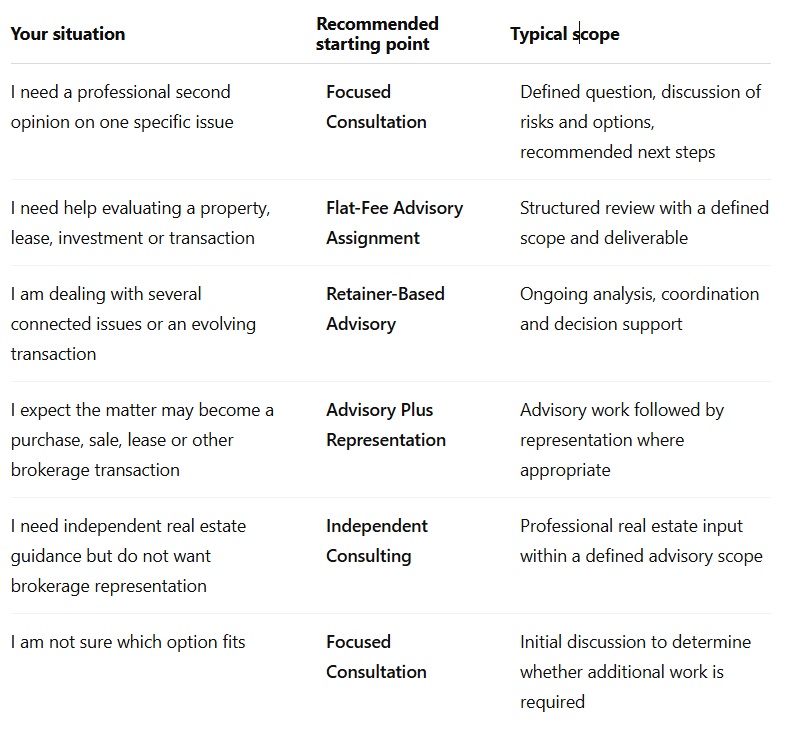
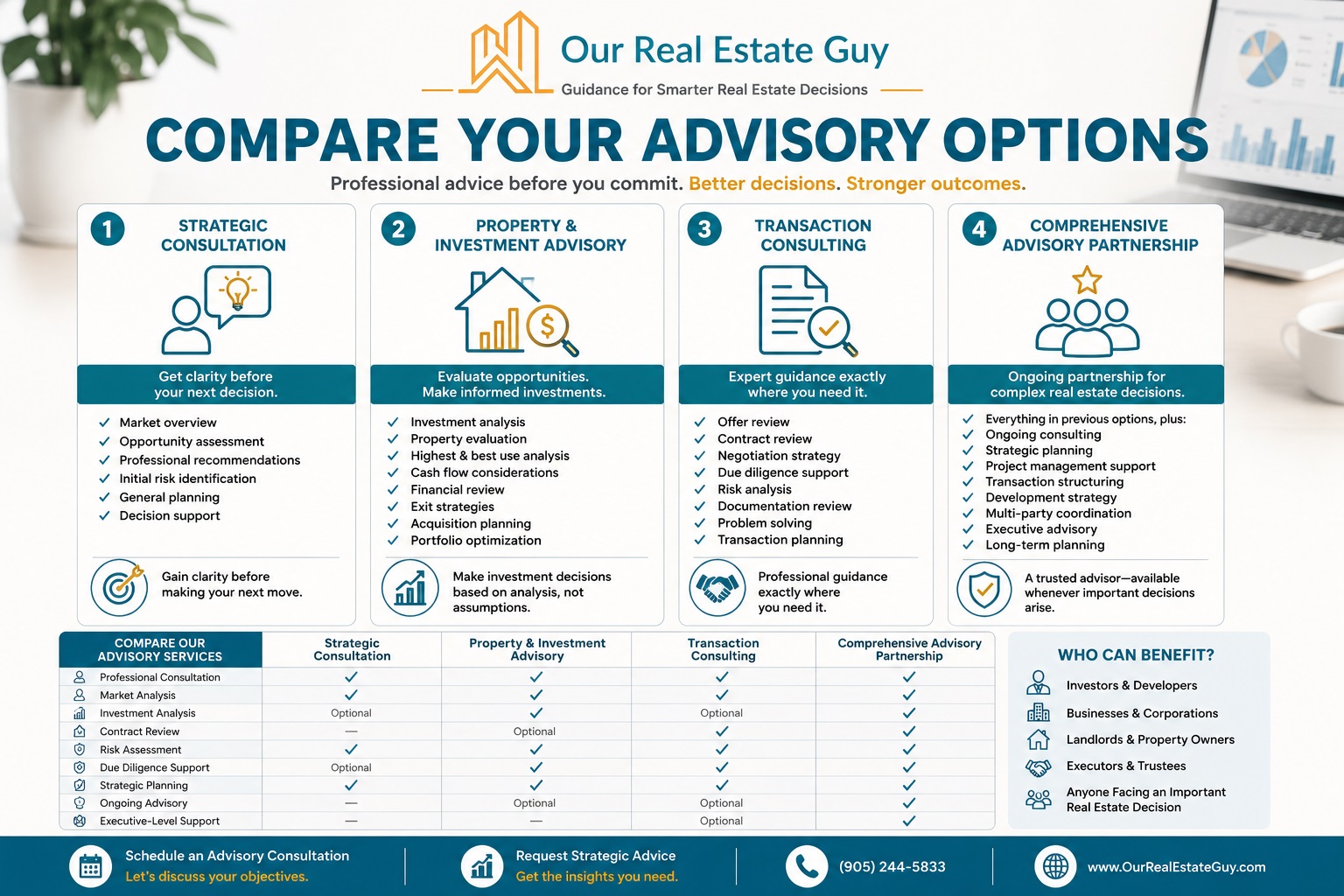
Compare Advisory Engagement Options
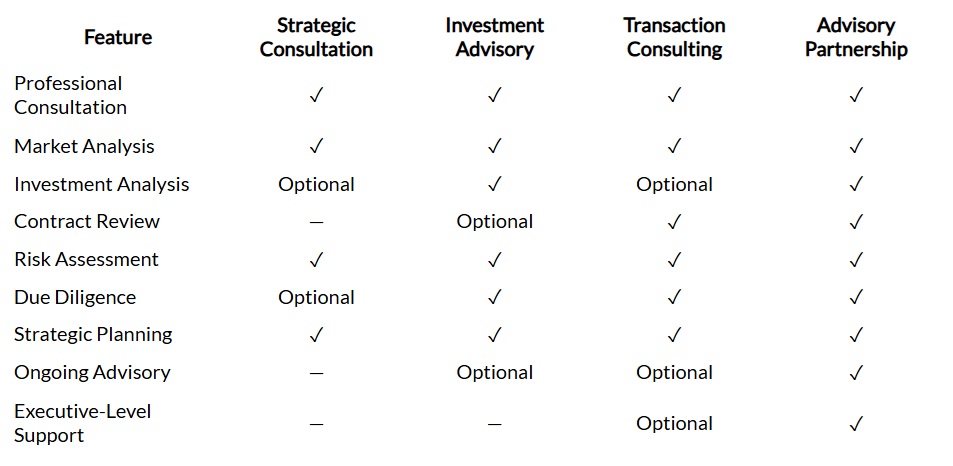
The comparison is intended as a guide. The scope can be adjusted where the client’s needs fall between categories or change as additional information becomes available.
Consulting Fee Structure
Advisory and consulting services are structured to remain transparent and proportionate to the assignment.
Focused Consultation
Designed for clients who need professional guidance before making a specific decision.
Typical fee: $295 to $395
A consultation may involve investment-property questions, commercial lease considerations, landlord or tenant risk, transaction structure, acquisition planning, second-suite considerations, due diligence concerns or another defined real estate issue.
Where brokerage representation is later engaged, consultation fees may be credited toward future representation or transaction services at my discretion.
Flat-Fee Advisory Assignments
More detailed or project-based advisory work may be quoted on a flat-fee basis.
Typical ranges include:
- Commercial lease review consultation: $495 to $1,500
- Investment acquisition advisory: $750 to $2,500
- Landlord risk and operational review: $495 to $1,500
- Transaction structure consultation: $750 to $2,500
- Due diligence coordination advisory: $1,000 to $5,000+
Fees are quoted in advance based upon scope, complexity, timing and the level of review required.
Advisory Plus Representation
Some matters begin as advisory assignments and later become brokerage transactions.
A client may initially need help understanding the issue, evaluating options or organizing due diligence before deciding whether formal buyer, seller, landlord or tenant representation is appropriate.
Where representation is subsequently engaged, the earlier advisory work can be incorporated into the later transaction rather than unnecessarily duplicated.
Retainer-Based Advisory
Investors, landlords, business owners or repeat clients who require ongoing guidance may prefer a monthly advisory retainer.
Typical monthly range: $500 to $2,500+
Retainer services may include ongoing acquisition discussions, property-review conversations, lease and occupancy strategy, landlord-risk guidance, investment planning and transaction preparation.
The scope and anticipated time commitment are established in advance.
Independent Consulting
Some clients require professional real estate input without brokerage representation.
Independent consulting may be appropriate for investors evaluating opportunities, business owners reviewing leasing options, landlords considering operational issues, tenants assessing occupancy concerns or buyers and sellers seeking a second perspective.
The engagement is provided within a defined scope and does not replace legal, accounting, tax, engineering, appraisal, environmental, insurance, financing or other specialized professional advice.
Professional Services Require Mutual Commitment
Professional representation involves a commitment on both sides. I commit professional time, analysis, negotiation, documentation, coordination and transaction support to the engagement, and clients are asked to make a corresponding commitment to the representation relationship.
The representation agreement explains when professional fees are earned and whether reasonable expenses may be reimbursable if the engagement ends before completion. These terms are reviewed before representation begins so that the financial commitment is understood in advance.
Professional Advice Sometimes Means Bringing in Other Professionals
Real estate advisory work frequently overlaps with legal, tax, accounting, financing, engineering, environmental and other specialized disciplines.
Where an issue requires expertise beyond the appropriate scope of real estate advisory services, I may recommend that the client obtain advice from an appropriately qualified professional.
The objective is not to provide every answer personally. It is to help identify which questions need answers before the decision is made and keep those issues coordinated within the broader real estate transaction.
From Advisory to Representation
Advisory and consulting services can remain independent, or they may lead naturally into buyer, seller, landlord or tenant representation where the client later requires transaction execution.
This allows the client to begin with the decision itself rather than having to begin by committing to a complete brokerage service model.
Explore Leasing Representation
Guidance for Smarter Real Estate Decisions
Professional advisory work is ultimately about improving the quality of the decision before the cost of reversing it increases.
That means helping clients understand what they are agreeing to, what they are assuming, what protection they may be giving up and what obligation they may be taking on.
The transaction may involve a residential purchase, commercial lease, investment property, landlord concern, assignment, due diligence issue or transaction structure. The questions change, but the objective remains the same:
Understand the decision before it becomes the commitment.
Related Articles & Resources
 Why Transaction Structuring Matters in Ontario Real Estate
Sophisticated Negotiations Involve More Than Price Alone
What Commercial Tenants Should Review Before Signing a Lease
Commercial Property Due Diligence Checklist
Common Litigation Issues in Agreements of Purchase and Sale
The Risks of Poorly Drafted Clauses in Ontario Real Estate
Why Documentation Matters in Real Estate Transactions
About Our Approach