


When mortgage rates begin to decline, it is understandable that prospective homebuyers may consider waiting. The reasoning seems straightforward: if borrowing becomes less expensive in the future, waiting for another rate reduction should make the eventual purchase more affordable.
But real estate affordability is determined by more than the mortgage rate alone. The price eventually paid for the property, the amount financed, available inventory, competition among buyers and the terms of the mortgage can all influence the actual cost of the decision.
That creates an important question for anyone waiting for better financing conditions: What happens if mortgage rates decline, but the property you eventually want to buy becomes more expensive while you wait?
The answer requires looking at the relationship between mortgage rates and property prices rather than considering either one independently.
A Lower Mortgage Rate Does Not Necessarily Mean a Less Expensive Purchase
Mortgage rates have an obvious effect on affordability. When rates decline, monthly payments on the same mortgage amount generally decline, and some buyers may qualify to borrow more. That can certainly benefit purchasers.
Lower borrowing costs, however, can also affect the behavior of other buyers. Consumers who postponed purchasing when financing costs were higher may return to the market, while increased purchasing capacity can allow some buyers to consider properties that were previously beyond their financing limits. If demand increases faster than available supply, some of the benefit created by lower mortgage rates can potentially be offset by higher property prices.
That does not mean declining mortgage rates will automatically cause property prices to rise. Real estate markets are influenced by many factors, including inventory, economic conditions, employment, population growth, consumer confidence and local supply and demand.
The more useful observation is that mortgage rates and property prices do not necessarily move independently of one another. A buyer waiting for improvement in one should consider what may happen to the other.
The GTA Market Provided an Interesting Example
When I originally examined this issue in the fall of 2025, the Greater Toronto Area provided an interesting illustration.
Despite a period that had included significant increases in borrowing costs, average GTA property prices had demonstrated considerable resilience. September 2025’s average selling price was approximately $1.1 million, providing a useful starting point for considering the relationship between purchase price and mortgage cost.
At the same time, mortgage rates had declined from their previous highs, while relatively high inventory in some market segments was providing buyers with greater selection and, depending upon the property, potentially greater negotiating opportunity.
Rather than attempting to predict where either rates or property prices would go next, the circumstances raised a useful financial question: Could a relatively modest increase in the purchase price offset the savings a buyer hoped to achieve by waiting for a lower mortgage rate?
Consider the Purchase Price and Mortgage Together
To illustrate the relationship, consider a purchaser evaluating a property priced at $1.1 million. Using the assumptions from my original analysis, the purchaser finances 80% of the purchase price, resulting in an $880,000 mortgage. A five-year fixed mortgage at 4.5% produces an estimated monthly payment of approximately $4,871.
Now assume the purchaser decides to wait for mortgage rates to decline to 4.0%. Waiting produces a lower interest rate, but what happens if the property increases in value during the same period?
Consider first a relatively modest $15,000 increase in the property price, or approximately 1.4%. The purchase price becomes $1,115,000 and, using the same 80% financing assumption, the mortgage increases to approximately $892,000. At the lower 4.0% rate, the estimated monthly payment declines to approximately $4,692—a saving of about $179 per month, or approximately $10,740 over five years.
The lower rate has clearly helped. But the purchaser is now paying another $15,000 for the property. After considering the estimated $10,740 mortgage-payment saving, the illustrative difference is approximately $4,260 against the purchaser.
Now suppose the property increases by $25,000, or approximately 2.3%. The purchase price becomes $1,125,000 and the mortgage increases to approximately $900,000. At 4.0%, the estimated monthly payment is approximately $4,734, producing a monthly saving of about $137 compared with the original mortgage. Over five years, that represents approximately $8,220 in lower mortgage payments.
But the purchaser has paid an additional $25,000 for the property. After subtracting the estimated $8,220 mortgage-payment saving, the illustrative difference becomes approximately $16,780 against the purchaser.
At a $45,000 property-price increase, or approximately 4.1%, the relationship becomes even more apparent. The purchase price becomes $1,145,000 and the mortgage increases to approximately $916,000. The estimated monthly payment at 4.0% is approximately $4,818, only about $53 less than the $4,871 payment under the original scenario. Over five years, the estimated mortgage-payment saving is approximately $3,180.
The purchaser has, however, paid another $45,000 for the property. After accounting for the estimated mortgage-payment saving, the illustrative difference becomes approximately $41,820.
The relationship can be summarized this way:
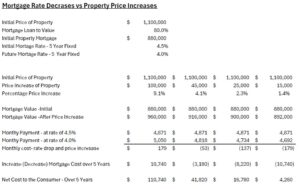
These examples are not predictions about where mortgage rates or property prices will go, nor are they intended to represent a complete cost-of-ownership analysis. They simply demonstrate the interaction between two variables that buyers sometimes consider independently.
A lower mortgage rate can reduce the cost of borrowing, but if the amount being borrowed increases because the property has become more expensive, some—or potentially all—of that benefit can disappear.
The important question isn’t simply whether the mortgage rate will be lower if you wait. It is whether the entire purchase will actually cost less.
Waiting Has a Cost — But So Does Buying Too Soon
It would be equally inappropriate to conclude from these examples that buyers should purchase immediately whenever mortgage rates are expected to decline.
Buying before you are financially prepared simply to avoid a possible future price increase can create a much larger problem. A purchaser needs to consider income stability, down payment, emergency reserves, monthly carrying costs, other debts and the likelihood of remaining in the property long enough for ownership to make sense. Property condition, location and suitability also matter. An attractively priced property is not a good purchase simply because the buyer fears prices may rise.
This is where the decision becomes more nuanced. Waiting is not automatically the safer decision, and buying now is not automatically the better decision. The objective is to understand what you are waiting for and whether obtaining it would materially improve your position.
Mortgage Policy Can Also Change Purchasing Power
Financing rules add another dimension to the decision.
Changes to Canada’s insured-mortgage framework expanded access to 30-year amortizations for certain borrowers and increased the insured-mortgage price cap to $1.5 million. Those measures provided additional financing flexibility for some purchasers and potentially expanded the number of consumers capable of competing for particular properties.
The broader lesson remains useful even as individual mortgage programs and qualification rules change. Financing policy affects purchasing power, and when governments or lenders change amortization options, qualification requirements, insured-mortgage limits or other financing rules, the effect should not necessarily be considered solely from the perspective of an individual borrower.
If a change improves purchasing capacity for many consumers at the same time, it can also influence demand within the housing market. This is another reason buyers should avoid evaluating a mortgage decision independently from the real estate market in which they will eventually use that mortgage.
Market Conditions Can Matter as Much as the Headline Rate
There is another consideration buyers sometimes overlook when deciding whether to wait: their negotiating position.
A market with relatively high inventory may provide greater property selection, more time to evaluate alternatives and, depending upon the property and local conditions, greater negotiating leverage. If market activity subsequently increases, a buyer may obtain a lower mortgage rate but encounter more competition for desirable properties, fewer negotiating opportunities or less flexibility around conditions.
Conversely, if inventory remains high or demand weakens, waiting could improve both financing costs and purchasing leverage.
Neither outcome can be known with certainty in advance. That is precisely why a buying decision should be based on more than a forecast of where mortgage rates might be several months from now.
The Right Question Is Not “When Will Rates Bottom?”
Trying to identify the lowest possible mortgage rate is similar to trying to identify the exact bottom of a real estate market. It may appear obvious afterward, but it rarely is beforehand.
A more practical approach is to determine the conditions under which purchasing makes sense for you. What price range can you comfortably afford? What monthly carrying cost is sustainable? What type of property meets your needs? How much cash should remain available after closing? What market conditions would provide an acceptable opportunity?
Once those parameters are understood, mortgage rates become one part of the decision rather than the decision itself. This allows buyers to evaluate opportunities as they appear instead of postponing every decision in anticipation of a financing condition that may or may not occur.
Investors Should Consider the Same Relationship Differently
For an investor, the analysis extends beyond monthly mortgage payments. Financing costs certainly affect cash flow, but so do acquisition price, expected rent, vacancy, operating expenses, maintenance, capital requirements and the investor’s anticipated holding period.
Waiting for a lower rate may improve financing costs, but an increase in acquisition price can affect the down payment required, mortgage principal, land transfer tax and eventual return on investment. Conversely, purchasing at a lower price does not make an investment attractive if the property cannot generate sufficient income to support its costs.
The appropriate question is therefore not simply whether financing is becoming cheaper. It is whether the property makes financial sense at the price, financing terms and operating assumptions available when the investment is being considered.
Make the Decision Based on Your Position, Not the Forecast
Real estate forecasts can be useful for understanding market conditions, but they should not substitute for an individual purchasing decision.
No one knows with certainty what mortgage rates, property prices or market activity will be several months from now. Even when a broader forecast proves correct, individual neighbourhoods, property types and price ranges can behave differently.
Buyers therefore benefit from understanding their own position first. If the right property is available, the purchase is comfortably affordable, financing is manageable and market conditions provide a reasonable opportunity, waiting exclusively for a somewhat lower mortgage rate may not necessarily improve the eventual outcome.
If those conditions are not present, however, the possibility of future price appreciation is not a reason to make a purchase that does not otherwise make sense.
The decision should begin with the buyer, not the prediction.
Final Thoughts
Mortgage rates matter, and property prices matter, but neither tells the complete story by itself.
A buyer waiting for mortgage rates to decline should also consider what may happen to property prices, inventory, competition and negotiating conditions during the same period. Likewise, a buyer concerned about future price increases should not allow that concern to override affordability, property suitability or financial preparedness.
The objective isn’t to perfectly predict the market. It is to understand the trade-offs involved in the decision.
Rather than asking only:
“Will mortgage rates be lower if I wait?”
Consider asking:
“If I wait, what else would need to happen for me to actually be better off?”
That question creates a very different conversation. It moves the decision away from trying to time a single market variable and toward evaluating the complete cost and opportunity of purchasing a property.
Guidance for Smarter Real Estate Decisions.
Written by Rodney Harvey, Broker of Record at Konfidis, Brokerage providing advisory-focused commercial, industrial, investment, and real estate brokerage services across Oshawa, Durham Region, and Ontario.
Related Articles & Resources
 What Sophisticated Investors Look for Before Buying Property in Durham Region
Understanding Cap Rates in Durham Region
7 Mistakes Buyers Make When Purchasing Investment Property in Oshawa
Assignment Sales and GST/HST Implications in Ontario
What Investors Should Know Before Creating a Second Suite in Ontario
Calculating Rental Property Profit in Ontario
What Do You Need to Know Before Buying Multi-Family Real Estate?
Put my expertise to work for you!
“If you require professional guidance regarding representation structure, transaction strategy, commercial leasing, investment property, due diligence, or real estate advisory services, consultation and representation options may be available depending on your objectives and circumstances.”