
When working with a REALTOR® in Ontario, one of the most important things to understand is who represents your interests and what that representation means in practical terms. Buyers and sellers often begin working with a real estate professional because they need help finding a property, marketing a home, negotiating an offer or managing a transaction. However, professional representation involves considerably more than completing forms or arranging showings.
A representation relationship establishes who is responsible for promoting and protecting the client’s interests, what services will be provided, how confidential information will be handled and what obligations exist between the client and the brokerage or designated representative. Understanding that relationship early helps clients make better decisions later, particularly if a transaction develops into a situation involving multiple representation.
Ontario’s current regulatory framework recognizes both brokerage representation and designated representation. Under brokerage representation, the brokerage represents the client and more than one agent within that brokerage may provide services to the client. Under designated representation, one or more specific agents are designated to represent the client, and confidential client information is generally restricted to those designated representatives.
The important point for the consumer is not simply which terminology appears in the representation agreement. It is understanding who is responsible for advocating for your interests and how that relationship may change if another client with competing interests becomes involved in the same transaction.
Why Representation Matters
Real estate transactions involve decisions that can have significant financial and legal consequences. A buyer may need advice about price, conditions, due diligence, financing, property risks and negotiation strategy. A seller may need guidance concerning pricing, offer evaluation, conditions, representations, competing offers and closing risk. In commercial and industrial transactions, the issues can become even broader and may include leases, environmental concerns, zoning, operating expenses, financing, redevelopment potential and operational suitability.
When you are represented, your representative is expected to promote and protect your interests within the scope of the representation relationship. That can involve advising you about the transaction, identifying risks, negotiating on your behalf, maintaining the confidentiality of information that could weaken your negotiating position and helping you understand the practical consequences of the decisions you are making.
This distinction becomes particularly important during negotiation. Information about the maximum price a buyer is prepared to pay, the minimum price a seller may accept, financial circumstances, motivation, urgency or negotiating strategy can materially affect the client’s position. Clients should therefore understand who is entitled to receive that information and who is obligated to keep it confidential.
Professional Insight: Representation is most valuable when it helps a client make better decisions, not simply when it provides someone to prepare documents. The relationship should give the client a clear source of advice, advocacy and transaction management throughout the process.
Understanding Brokerage Representation and Designated Representation
Under brokerage representation, the representation relationship exists between the client and the brokerage. This means that multiple agents within the brokerage may provide services to the client, subject to the brokerage’s policies and confidentiality obligations. Because the brokerage itself represents the client, multiple representation can arise if that brokerage also represents another client with competing interests in the same transaction.
Under designated representation, the brokerage designates one or more specific agents to represent the client. Those designated representatives are responsible for promoting and protecting that client’s interests, while confidential information is generally restricted from other agents within the brokerage who are not involved in that client’s representation. RECO explains that when a seller and buyer are represented by different designated representatives within the same brokerage, the agents may continue to represent their respective clients fully and the situation is not considered multiple representation.
This distinction is important because many consumers understandably assume that using the same brokerage automatically means that a conflict exists. That may be true under brokerage representation, but it is not necessarily true under designated representation. The applicable representation model determines when competing interests within the same brokerage create multiple representation.
What Multiple Representation Means
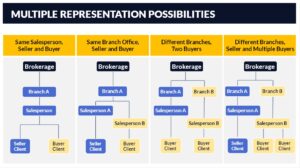
Multiple representation occurs when a brokerage or designated representative represents more than one client with competing interests in the same transaction. Under brokerage representation, this can occur where the brokerage represents both the seller and the buyer, or where it represents two or more competing buyers interested in the same property. This remains true even where those clients are working with different agents within the brokerage.
Under designated representation, multiple representation is narrower. It generally arises when the same designated representative represents both the seller and buyer in the same transaction, or represents two or more competing buyers. Where different designated representatives within the same brokerage represent the competing clients, those representatives can ordinarily continue advocating for their respective clients without creating multiple representation.
The practical importance of multiple representation is that the ability to provide unrestricted advice and advocacy changes. A representative cannot fully promote one client’s negotiating interests against another client’s competing interests while simultaneously owing representation obligations to both. The issue is therefore not simply that two clients happen to be connected to the same brokerage or agent. The real concern is how competing interests affect the advice, advocacy and confidential information that can be provided.
Multiple Representation Can Arise in More Than One Way
The most familiar example occurs when the same representative or brokerage represents both the seller and a buyer in the same transaction. The seller naturally wants to obtain the best available price and terms, while the buyer generally wants to acquire the property on the most favourable terms possible. Those interests are inherently different, which is why the representation relationship must be addressed before both clients can continue under multiple representation.
A less obvious situation arises where two buyers represented within the same brokerage become interested in the same property. Under brokerage representation, those buyers may become competing clients of the same brokerage even though different agents are assisting them. Under designated representation, however, two competing buyers represented by different designated representatives within the same brokerage can ordinarily continue receiving full representation from their respective representatives.
This difference demonstrates why consumers should understand the representation structure established at the beginning of the relationship. Multiple representation is not simply determined by whether the same brokerage name appears on both sides of the transaction. It depends upon how the clients are represented and where the representation obligations reside.
What Changes When Multiple Representation Occurs
When multiple representation arises, the most important issue for the client is not the administrative process used to document it. The important issue is understanding how representation changes.
A representative involved in multiple representation cannot advocate for one client in a manner that disadvantages another represented client. Certain advice that would normally form part of single representation may therefore become restricted. The representative also remains responsible for protecting confidential information and cannot disclose information from one client simply because that information might benefit the other.
For example, a seller’s willingness to accept less than the asking price, a buyer’s willingness to offer more, personal motivations for completing the transaction or confidential negotiation strategies are all types of information that can materially influence bargaining positions. The protections surrounding that information remain important when competing clients are involved.
This does not mean that multiple representation is inherently improper or that a transaction cannot proceed successfully. It means the client needs to understand that the nature of the service has changed and decide whether that modified relationship remains appropriate for the transaction.
Consent to Multiple Representation Should Be an Informed Decision
Ontario does not permit multiple representation simply because a brokerage or representative wishes to continue acting for everyone involved. RECO requires written disclosure and written consent from each affected client before the brokerage or designated representative can continue representing multiple clients with competing interests.
The important part of that process is not the signature itself. Before agreeing, the client should understand how multiple representation will affect the services and advice they receive, what information must remain confidential and what alternatives are available if they are not comfortable proceeding.
A client may decide that the limitations are acceptable because the transaction is relatively straightforward, because they already have substantial professional advice from other sources or because they otherwise consider the arrangement manageable. Another client may conclude that independent representation is more appropriate, particularly where negotiation is complex or the financial consequences are substantial.
Professional Insight: Consent to multiple representation should be treated as a decision about the quality and independence of the advice the client wishes to receive, not simply as another disclosure requiring a signature.
What Happens if You Do Not Consent
Clients are not required to accept multiple representation. If a situation arises and one or more clients do not consent, the brokerage or representative cannot simply continue representing all competing clients in the same manner. One or more of the affected clients may need to obtain alternative representation so that the conflict is removed. RECO’s current guidance is explicit that multiple representation cannot continue unless each affected client agrees.
That option is important because consumers should never feel that they must accept reduced advocacy merely because a transaction has developed in a particular way. The purpose of disclosure and consent is to allow clients to understand the circumstances and decide whether they remain comfortable with the proposed representation structure.
In a competitive residential transaction, a buyer may prefer to continue working with the representative who already understands their circumstances. In another situation, the buyer may value unrestricted negotiation advice more highly and decide that separate representation is preferable. Neither decision is automatically correct. The appropriate choice depends upon the transaction and the client’s needs.
Multiple Representation Should Not Be Judged Primarily by Commission
Historically, multiple representation has sometimes been described in terms of the possibility of commission savings or the perceived convenience of having fewer representatives involved. Those considerations may occasionally arise, but they should not become the primary basis for deciding whether the arrangement is appropriate.
Remuneration is negotiated within the transaction and should not be assumed to change simply because multiple representation occurs. More importantly, any possible financial saving should be considered alongside the change in advocacy and advice. Saving money on remuneration offers little advantage if the client gives up professional guidance that would have materially improved the negotiation or helped identify an important risk.
The more useful question is whether the representation structure allows the client to receive the level of advice and advocacy required for the particular transaction. In a relatively straightforward transaction, the client may be comfortable proceeding. In a complex negotiation involving substantial financial exposure, independent representation may carry greater value.
Representation Matters in Commercial and Industrial Transactions Too
The principles of representation apply just as strongly in commercial and industrial real estate, even though the issues being negotiated may be considerably more complex.
A commercial purchaser may require advice concerning price, financing, lease review, environmental conditions, zoning, building systems, operating expenses and future marketability. An industrial purchaser may need to consider electrical capacity, shipping configuration, outdoor storage, servicing, environmental history or whether the site can support the intended business operation. Sellers and landlords may simultaneously be negotiating price, representations, due diligence access, lease terms or risk allocation.
When competing clients are involved in transactions of this nature, limitations on advocacy can have significant consequences because the negotiation may involve much more than simply agreeing upon price. The parties may be deciding who will assume environmental risk, whether representations survive closing, how repairs will be handled or how extensive the purchaser’s due diligence rights will be.
For this reason, commercial clients should understand the representation structure just as clearly as residential consumers. The more complex the transaction, the more important it becomes to understand who is providing independent strategic advice and whether any conflict has changed the scope of that advice.
The RECO Information Guide Is Intended to Help Consumers Understand Their Options
Ontario requires buyers and sellers to receive the RECO Information Guide before services or assistance are provided by a real estate agent. The guide explains representation, self-representation and multiple representation so consumers can understand the available relationship options before entering into an agreement with a brokerage.
The guide should not be viewed simply as another regulatory document. It provides an opportunity to discuss what representation means before a transaction becomes complicated. Buyers and sellers should understand whether they will receive brokerage representation or designated representation, who will have access to confidential information and what could happen if competing interests later arise.
Asking those questions at the beginning is considerably easier than trying to understand the representation relationship after an offer has already been prepared or a multiple representation situation has emerged.
Good Representation Should Be Understandable
The value of professional representation depends partly upon the client understanding the relationship. A buyer or seller should know who represents them, what services are being provided, what information will remain confidential and how the representative will advocate for their interests.
That understanding becomes especially important when the transaction changes. Competing buyers may emerge, a buyer represented by the listing brokerage may become interested in the property or another circumstance may create multiple representation. At that point, the client should understand what has changed and what choices remain available.
Professional representation should therefore not be something consumers discover through forms after the fact. It should be discussed early enough that the client can make informed decisions throughout the transaction.
Choosing the Representation Structure That Fits the Transaction
There is no single representation structure that is automatically best for every buyer or seller. Brokerage representation and designated representation can both provide effective professional representation when they are properly understood and administered. Multiple representation can also be appropriate in some circumstances, provided the affected clients understand the limitations and give informed consent.
The decision should ultimately reflect the nature of the transaction and the client’s need for independent advice. A straightforward residential purchase may present very different considerations from a contested multiple-offer situation, just as a conventional home sale differs significantly from a complex industrial acquisition involving environmental, zoning and operational risks.
What matters most is that the representation relationship supports the decision the client is making. Clients should understand who is responsible for protecting their interests, where confidential information will be held and whether competing interests have changed the advice and advocacy they can expect to receive.
Working with a REALTOR® should therefore involve more than knowing the name of the person handling the transaction. It should involve understanding the professional relationship behind that representation and how it helps protect the client’s interests from the beginning of the transaction through closing.
Guidance for Smarter Real Estate Decisions.
This article is provided for general information purposes only and does not constitute legal advice. Representation relationships and obligations depend upon the particular representation agreement, brokerage model and circumstances of the transaction. Buyers and sellers should review the RECO Information Guide, discuss representation options with their real estate professional and obtain independent legal advice where appropriate.
Written by Rodney Harvey, Broker of Record at Konfidis, Brokerage providing advisory-focused commercial, industrial, investment, and real estate brokerage services across Oshawa, Durham Region, and Ontario.
Continue Building Your Transaction Knowledge
You may also find these articles helpful:
 Understanding the RECO Information Guide and Your Representation Options in Ontario Real Estate
What Real Estate Consumers Should Expect From Their Brokerage
Flexible Representation Options Exist in Ontario Real Estate
Why Proper Representation Agreements Protect Consumers
Is It Okay to Have Multiple Real Estate Agents?
Your REALTOR® is Asking Questions Because…it’s the Law
Professional Representation Has Real Value
Put my expertise to work for you!
“If you require professional guidance regarding representation structure, transaction strategy, commercial leasing, investment property, due diligence, or real estate advisory services, consultation and representation options may be available depending on your objectives and circumstances.”